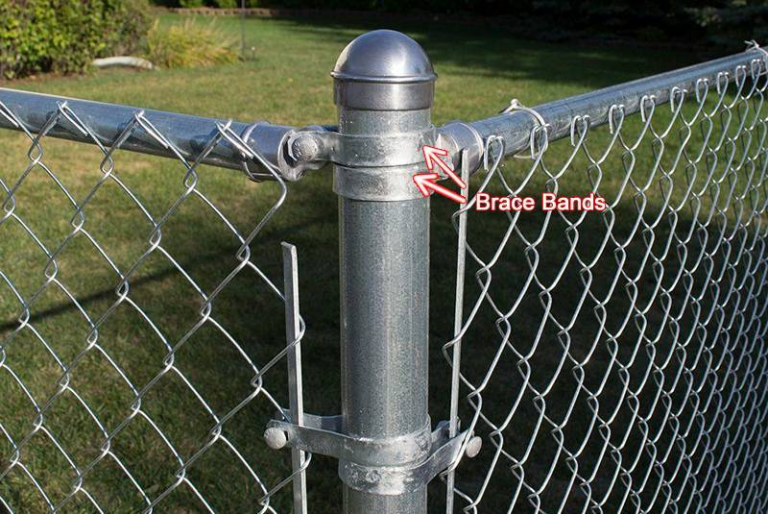
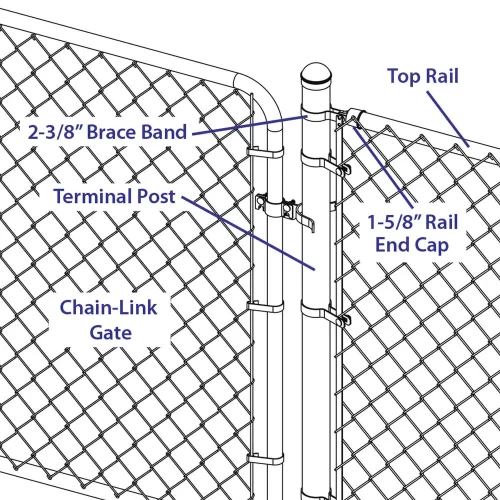
So, you’re building a chain-link fence. You’ve got your posts, your mesh, and your rails. Then you open the hardware kit and see those curved, metal pieces called tension bands. The big question hits you: “How many of these things do I actually need to buy for this whole project?” Buying too few means a frustrating trip back to the store. Buying too many is a waste of money. Let’s break it down into a simple, no-nonsense formula so you can get your shopping list right.

- The Rule: Use three tension bands per terminal post.
- Terminal Posts Defined: These are your fence’s anchor points: end posts, corner posts, and gate posts.
- Line Posts Need Zero: The posts in between terminals don’t use any tension bands.
- The Formula: Total Tension Bands = (Number of Terminal Posts) x 3
- A Simple Example: A basic rectangular yard has 4 corners. 4 corners x 3 bands each = 12 tension bands total.
- Goal: To give you the confidence to calculate the exact quantity needed for your specific fence layout.
Table of Contents
Introduction
The One-Minute Answer: The Golden Rule
What’s a “Terminal Post” Anyway?
Your Step-by-Step Calculation Guide
A Real-World Example (Let’s Do the Math!)
What NOT to Do: Common Mistakes
Frequently Asked Questions (FAQs)
The One-Minute Answer: The Golden Rule
If you’re in a hurry, here’s the only rule you need to remember:
You need three tension bands for every single terminal post on your fence.
That’s it. This isn’t a suggestion; it’s the industry standard for a strong, secure fence that can handle years of tension without sagging or failing. The whole question of how many tension bands for a chain link fence you need boils down to one thing: accurately counting your terminal posts.
What’s a “Terminal Post” Anyway?
This is the most important part of the calculation. You can’t count them if you don’t know what they are! Terminal posts are the backbone of your fence. They are:
- Corner Posts: Any post where the fence changes direction. (Most fences have at least four).
- End Posts: The posts that mark the very beginning and end of a fence run.
- Gate Posts: The two posts that support your gate. These are a special type of end post.
These posts are set in concrete and are built to handle the massive horizontal pull from the stretched chain-link fabric. The tension bands are the hardware that transfers that force from the fabric into these strong posts.
Table: Post Types & Their Hardware Needs
| Type of Post | Number of Tension Bands Needed | Why? |
|---|---|---|
| Terminal Post (End, Corner, Gate) | 3 | To anchor the end of the chain-link fabric and handle all the tension. |
| Line Post (The “in-between” posts) | 0 | These just support the top rail; the fabric is simply tied to them with wire. |
Your Step-by-Step Calculation Guide
Ready to do the math for your own yard? Follow these three simple steps:
- Draw a Quick Sketch: Grab a piece of paper and draw a rough layout of your fence. Mark every place where the fence will end or make a corner.
- Count All Terminal Posts: On your sketch, place a dot and label every single:
- Corner Post
- End Post
- Gate Post
Now, add them all up. This is your total number of terminal posts.
- Multiply by Three: Take that total number and multiply it by 3.
Total Tension Bands Needed = (Number of Terminal Posts) x 3
That’s your final number. It’s that simple.
A Real-World Example (Let’s Do the Math!)
Let’s imagine a typical backyard. The fence will be a rectangle, but with a single gate in the middle of one side.
- Step 1: Count the Corners. A rectangle has 4 corner posts.
- Step 2: Count the Gates. The gate has two posts (one on either side). These are 2 gate posts. Since the gate is on a straight run, these posts also act as end posts for the sections on either side of the gate.
- Step 3: Add Them Up. 4 Corners + 2 Gate Posts = 6 Terminal Posts.
- Step 4: Multiply by Three. 6 Terminal Posts x 3 Bands Each = 18 Tension Bands.
So, for this project, you would need to buy 18 tension bands total.
What NOT to Do: Common Mistakes
Even with a simple formula, it’s easy to slip up. Here’s what to avoid:
- Counting Line Posts: Remember, the dozens of posts running in a straight line between your terminals? They get ZERO tension bands. Don’t add them into your count.
- Using Less Than Three: Trying to save a few bucks by using only two bands per post is a bad idea. It concentrates too much force on one point and can lead to a saggy fence or even a broken post.
- Forgetting the Gate: Gates are the most common thing to forget! A gate requires two terminal posts, which means you need to add 6 tension bands (2 posts x 3 bands) to your total count.