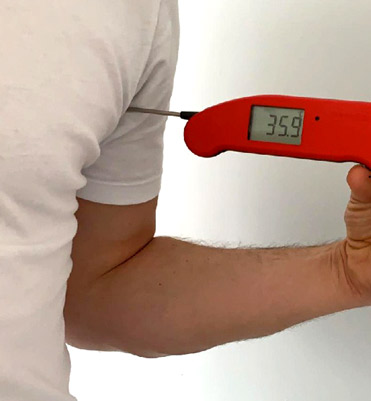
Have you ever wondered if you could grab a kitchen thermometer and use it to check your own temperature? Maybe you were in a pinch, feeling a bit under the weather, and thought, “Hey, this thing measures heat—why not?” Before you do that, let’s pause for a second. Kitchen thermometers are built for food, not humans, and using them on yourself can give inaccurate results or even pose health risks. In this article, we’ll break down why a kitchen thermometer isn’t the right tool, what alternatives you should use, and some quick tips for safely checking your temperature at home.

? Quick Highlights
- Kitchen thermometers are made for food, not people.
- Using one on yourself gives inaccurate readings.
- Medical thermometers are calibrated for human body temperature.
- Hygiene matters—don’t share kitchen probes with your mouth or skin.
- Infrared or digital thermometers are the safe alternatives.
- Fever detection needs reliable tools, not DIY hacks.
- Some products are budget-friendly and super easy to use.
Table of Contents
- ? Kitchen Thermometers vs Medical Thermometers
- ? Why You Shouldn’t Use a Kitchen Thermometer on Yourself
- ? Safety and Accuracy Concerns
- ? Recommended Thermometers for Home Use
- ? Tips for Checking Your Temperature Safely
- ? FAQ
? Kitchen Thermometers vs Medical Thermometers
Let’s be real—kitchen thermometers are awesome for making sure your chicken is cooked to perfection, but they’re not designed to measure your body temperature. Most kitchen thermometers measure a super wide range, like -50°C to 300°C (-58°F to 572°F). Your body? It’s only around 36–42°C (97–108°F). So yeah… the reading is going to be way off.
Pro tip: stick to a medical thermometer if you want an actual answer.
? Why You Shouldn’t Use a Kitchen Thermometer on Yourself
- Accuracy matters: Body temperature is a narrow range. Kitchen thermometers aren’t precise enough.
- Hygiene alert: Food thermometers can carry bacteria—definitely not something you want on your mouth or skin.
- Safety first: Some probes are pointy or not designed for oral/ear use.
? Safety and Accuracy Concerns
| Factor | Kitchen Thermometer | Medical Thermometer |
|---|---|---|
| Temp Range | -50°C to 300°C | 35°C to 42°C |
| Accuracy | ±2°C (maybe more) | ±0.1–0.2°C |
| Designed For | Food, liquids | Human body |
| Health Risk | High if misused | Minimal |
? Recommended Thermometers for Home Use
Here are a few affordable and reliable options you can consider (affiliate-friendly):
- Digital Medical Thermometer – Fast, accurate, and works for oral, rectal, or underarm readings. Great for families.
- Infrared Forehead Thermometer – No contact needed, perfect for kids and adults. Super convenient.
- Smart Thermometers – Some connect to your phone for tracking trends over time.
? Tip: Always check for FDA-approved or clinically tested thermometers to ensure safety.
? Tips for Checking Your Temperature Safely
- Clean your thermometer before and after each use.
- Follow the instructions—placement matters for accuracy.
- If results seem weird, take a second reading.
- Avoid using kitchen tools as a DIY substitute—they’re fun for cooking, not health.
? FAQ
Q1: Can a kitchen thermometer detect a fever?
A1: Nope. It’s not designed for human temperatures, so you’ll get inaccurate readings.
Q2: What happens if I use it anyway?
A2: You risk wrong readings, hygiene issues, and potential injury.
Q3: Are all food thermometers unsafe for humans?
A3: Yes, they’re built for culinary purposes, not your body.
Q4: Can an infrared thermometer replace a medical thermometer?
A4: Absolutely. They’re safe, fast, and reliable.
Q5: How do I measure my baby’s temperature safely?
A5: Digital rectal thermometers give the most accurate results for infants.
Q6: Can I use a kitchen thermometer in an emergency?
A6: It’s not recommended—accuracy is too unreliable for health decisions.
Q7: How should I clean a thermometer?
A7: Alcohol wipes or soap and water before and after use.
Q8: What’s the difference between a cooking and medical thermometer?
A8: Cooking thermometers handle wide temp ranges; medical thermometers are precise for the human body.